KACUNS 학술회의_영문 Activities
-
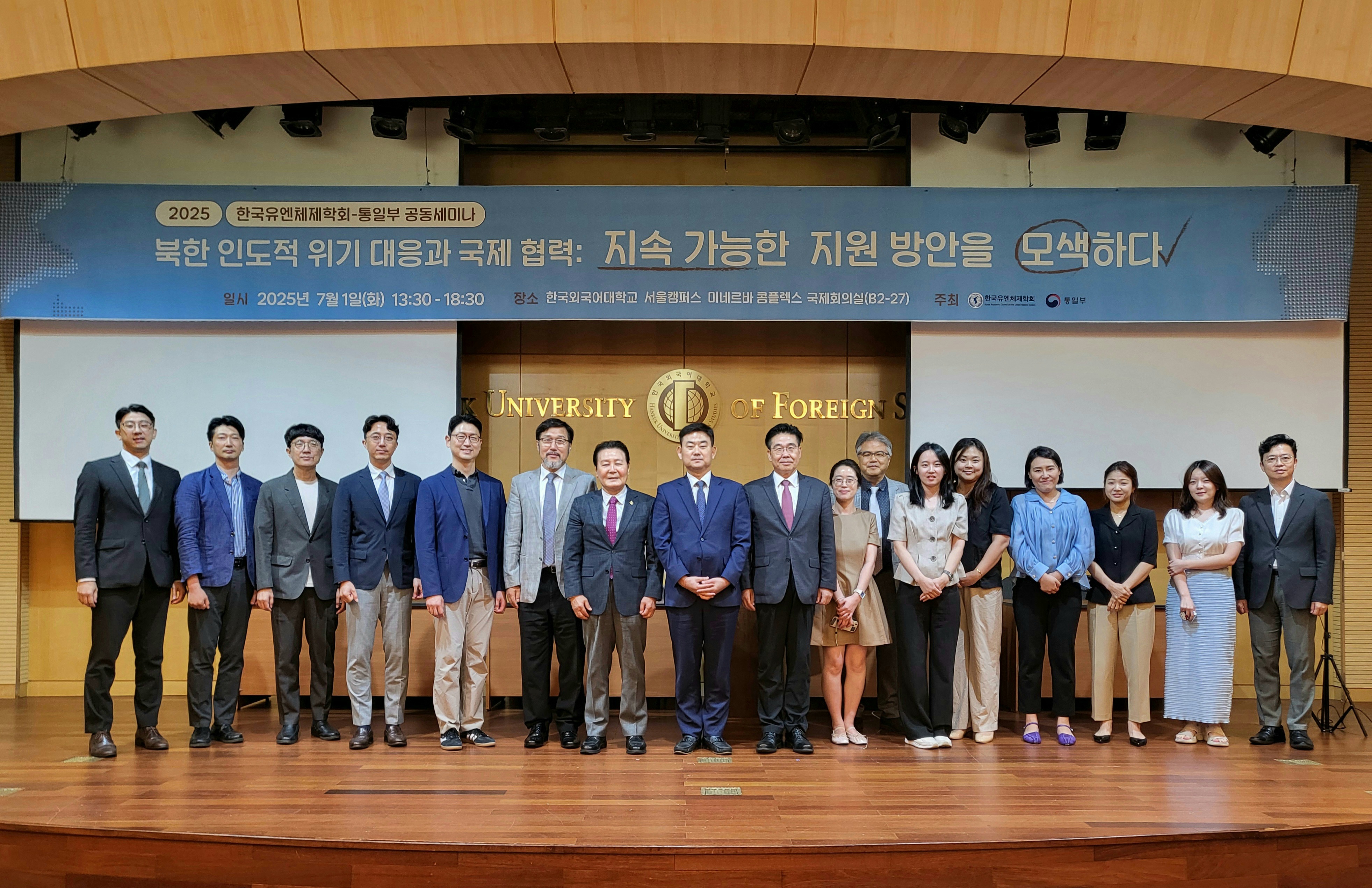
2025 KACUNS–Ministry of Unification Joint Seminar
Title: Responding to North Korea’s Humanitarian Crisis and International Cooperation: Exploring Sustainable Support StrategiesDate & Time: Tuesday, July 1, 2025, 13:30–18:30Venue: Hankuk University of Foreign Studies (Seoul Campus), International Conference Hall (B2-27)Format / Language: In-person/ KoreanParticipants: Government, international organizations, NGOs, academia, media, and related practitionersThe seminar examined North Korea’s prolonged humanitarian crisis and explored how international cooperation can deliver sustainable, effective, and principled support. Discussions also highlighted the importance of multilateral coordination, transparency, and trust in humanitarian assistance.▶ Opening & Keynote (13:30–14:20)•Opening Remarks: Jae Jeok Park (President, KACUNS)•Congratulatory Remarks: Jongseok Kang (Director-General, Human Rights & Humanitarian Affairs Office, Ministry of Unification)•Welcome Remarks: Daewon Ohn (HUFS)•Keynote: Seung-yul Lee (Northeast Asia Community Culture Foundation)▶ Session 1 (14:30–15:45) — The Present and Future of Humanitarian Assistance to North Korea: International Cooperation and Implementation Strategies•Chair: Daewon Ohn (HUFS)•Presenters: Sohee Hwang (Yonsei University); Jiyoung Kim (Soongsil University); Jinyoung Lee (Jeonbuk National University)•Discussants: Youngchul Cho (Kangwon National University); Woochul Kang (Eximbank of Korea); Hyunjin Choi (Kyung Hee University)▶ Session 2 (16:00–17:15) — Humanitarian Conditions on the Korean Peninsula and International Solidarity•Chair: Juseong Lee (Secretary-General, Bukminhyup)•Presenters: Hyojung Kim (Kyung Hee University); Chunheung Mo (Hanyang University); Sungchul Kang (Soongsil University)•Discussants: Junmo Lee (Concern Worldwide); Sangseob Ha (Yonsei University); Kyungseok Lee (Incheon National University)▶ Roundtable (17:30–18:30) — Sustainable Humanitarian Cooperation: Strategies and Partnerships for Supporting North Korea•Chair: Suk-Hoon Hong (Changwon National University)•Participants: Emma Campbell (Médecins Sans Frontières); Seongeun Kim (UN ESCAP); Hansol Jang (World Vision); Sangyoung Hong (Korea Sharing Movement)관리자
2026.01.15
-
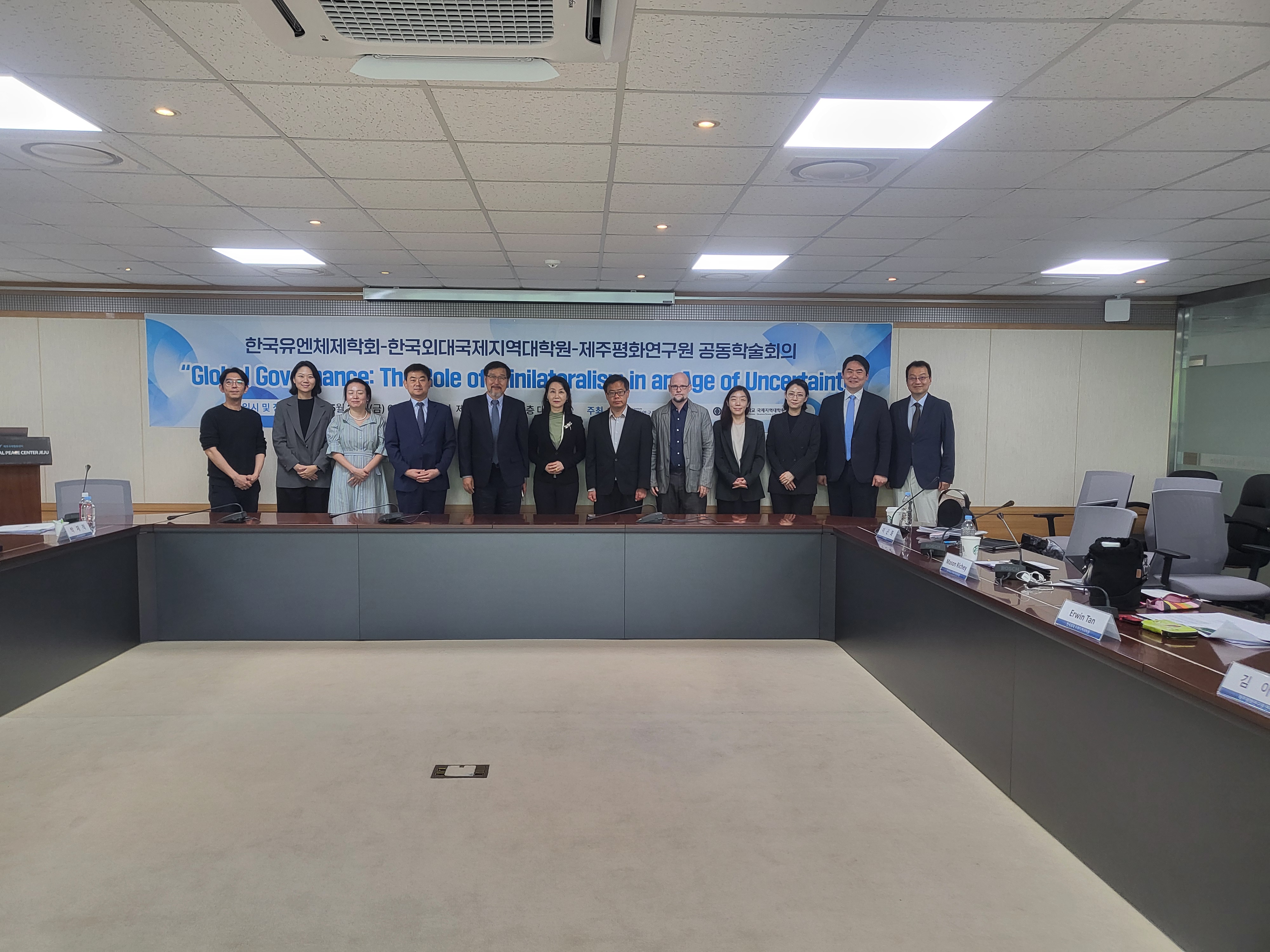
Joint Academic Conference: Global Governance and Minilateralism
Conference Theme: "Global Governance: The Role of Minilateralism in an Age of Uncertainty"Date: Friday, May 30, 2025Time: 08:40–12:10Venue: Jeju Peace InstituteOrganizers: Korea Academic Council on the United Nations System (KACUNS), Graduate School of International and Area Studies (GSIAS) at Hankuk University of Foreign Studies, Jeju Peace Institute▶ Session 1: Minilateralism for Sustainable DevelopmentChair: Prof. Shin-wha Lee (Korea University)The session discussed targeted minilateral cooperation aimed at achieving Sustainable Development Goals (SDGs).Presenters: Prof. Su-Weon Kim (HUFS), Prof. Bo-Kyung Kim (Jeonbuk National University), Dr. Hyojung Kim (Kyung Hee University), Prof. Soo-Jin Han (Sookmyung Women’s University), Dr. Dong-Joon Park (Jeju Peace Institute)Discussion: Conducted in Korean▶ Session 2: The Rise of Minilateral CooperationChair: Prof. Daewon Ohn (HUFS)This session explored the implications of minilateral cooperation for global governance, emphasizing its potential impact and challenges.Presenters: Prof. Mason Richey (HUFS), Prof. Erwin Tan (HUFS), Dr. Aram Kim (Jeju Peace Institute), Dr. Kyoung-Seok Ha (Institute for National Security Strategy), Dr. Ki-Tae Lee (Sejong Institute)Discussion: Conducted in English관리자
2026.01.15
-
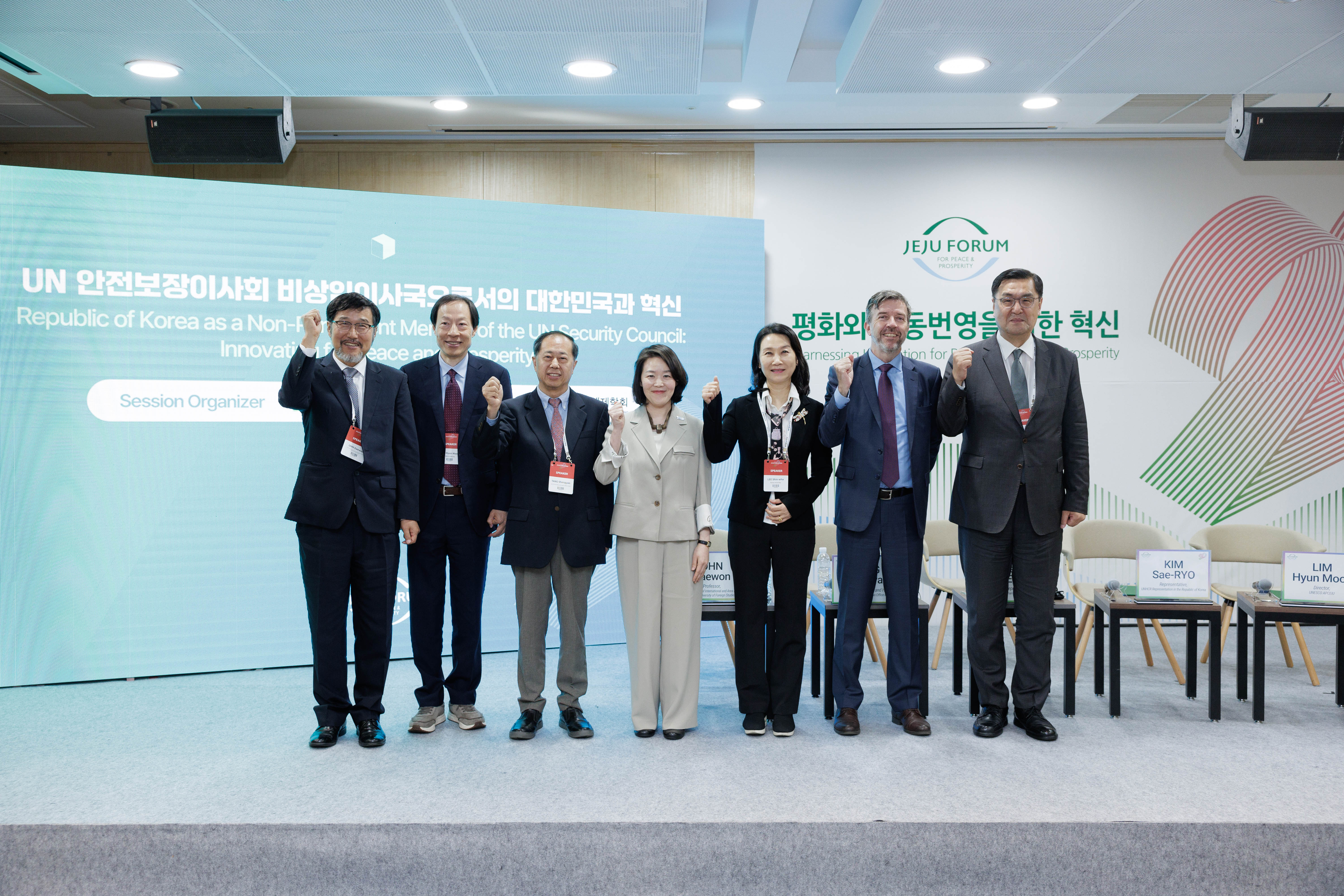
20th Jeju Forum
On Thursday, May 29, 2025, Korean Academic Council on the UN System (KACUNS) hosted a special session titled "Republic of Korea as a Non-Permanent Member of the UN Security Council: Innovating for Peace and Prosperity" at the 20th Jeju Forum. Conference Theme: Harnessing Innovation for Peace and Shared ProsperitySession Title: Republic of Korea as a Non-Permanent Member of the UN Security Council: Innovating for Peace and ProsperityDate: Thursday, May 29, 2025Time: 17:10–18:40 (90 minutes)Venue: International Convention Center JEJU, Room 203Hosts: Jeju Peace Institute; Korean Academic Council on the UN System (KACUNS); Graduate School of International and Area Studies (GSIAS), Hankuk University of Foreign Studies (HUFS)This session discussed the Republic of Korea’s role as a non-permanent UN Security Council member. Panelists addressed innovative strategies for managing geopolitical instability, including U.S.-China rivalry, regional tensions in East Asia, and global conflicts.The session was moderated by Professor Daewon Ohn, Dean of the Graduate School of International and Area Studies at Hankuk University of Foreign Studies. Presentations were delivered by Shengyao Tang (FAO Korea), James Heenan (UN Human Rights Office Seoul), Saerye Kim (UNHCR Korea Office), and Hyun Mook Lim (UNESCO APCEIU). Kyung-Chul Lee (Senior Representative for UN Security Council Affairs, Ministry of Foreign Affairs, ROK) and Professor Shin-Wha Lee (Korea University, former President of KACUNS) participated as discussants.관리자
2026.01.15
-
![[The Korea Herald] How can South Korea leverage its UN Security Council seat?](/upload/board/board_p_1717727215_1.jpg)
[The Korea Herald] How can South Korea leverage its UN Security Council seat?
On the 30th at Jeju International Convention Center, the participants of the "19th Jeju Forum for Peace and Prosperity"are posing for a group photo."How can South Korea leverage its UN Security Council seat?"South Korea can play a bigger role amid increased divisions among the P5 at Security Council, says senior Foreign Ministry officialJEJU ISLAND -- As a non-permanent member of the UN Security Council, South Korea is uniquely positioned to address not only North Korean issues but also pressing global challenges, leveraging its strengths — successful experiences and significant global contributions in areas such as food security and peacekeeping operations, senior UN officials and experts emphasized on Thursday.Furthermore, South Korea's direct concern with the impact of human rights violations on security — especially the ramifications of North Korea's human rights violations on its denuclearization — highlights its potential to prioritize critical agenda items in the UN Security Council, according to the experts based in Seoul.As South Korea is set to take on the rotational presidency of the UN Security Council in June, senior UN officials and experts discussed the agenda topics South Korea should prioritize at the Security Council during a separate session at the nineteenth Jeju Forum. Ji Da-gyumView Original Article관리자
2024.06.05
-
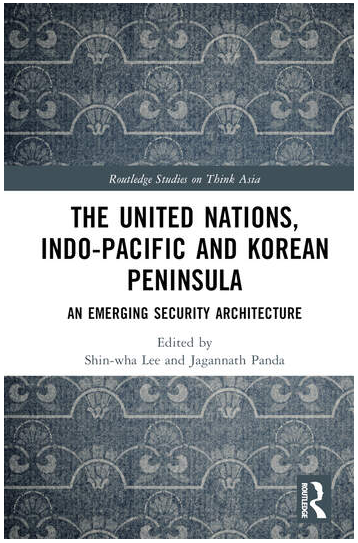
Routledge Publication: Shin-wha Lee and Jagannath Panda eds. The United Nations, Indo-Pacific and Korean Peninsula: An Emerging Security Architecture (Routledge, 2023)
URL: https://www.routledge.com/The-United-Nations-Indo-Pacific-and-Korean-Peninsula-An-Emerging-Security/Lee-Panda/p/book/9781032460680The Korea Academic Council on the United Nations System (KACUNS) recently published The United Nations, Indo-Pacific and Korean Peninsula: An Emerging Security Architecture (Routledge, 2023) in August, 2023. The book project reflected the vision of KACUNS to not only promote research on the impact of the UN system on regional and global peace but also educate the international audience on the importance of multilateral diplomacy through the UN. Moreover, the project was the culmination of thoughtful interactions among UN experts from around the world and of different generations. The direction and theme of the book were shaped through numerous meetings beginning with the kick-off meeting held in July 2021. The contents of the book were finalized after receiving feedback from experts who commented on the chapters during the 2021 KACUNS Annual Summer Conference (August 2021) and the United Nations, Indo-Pacific, and Korean Peninsula online workshop (December 2021), both hosted by KACUNS.The United Nations, Indo-Pacific and Korean Peninsula focuses on the United Nations (UN) and its frameworks to examine the power politics in two of the world’s more politically sensitive and geo-strategically crucial regions of the Korean Peninsula and the Indo-Pacific.This book provides answers to broader questions that are relevant to the global emerging peace architecture. The book is divided into three parts: global, the Indo-Pacific, and the Korean Peninsula. The first part analyses the competing world views of the US, China, Japan, and Korea and the evolvement of UN debates on global and regional security, with special emphasis on the Indo-Pacific and the Korean Peninsula. The second part concerns major bilateral or multilateral security issues facing Indo-Pacific countries and their UN debates in this regard. In particular, with new developments in the Indo-Pacific, such as the Quad process involving the Australia-India-Japan-United States and an anticipation expansion of the Group of Seven (G-7), chapters analyze how these mechanisms expand their focus within the scope of Indo-Pacific power politics. Part three focuses on the UN-centered debates on the two Koreas and their strategic fallouts at regional and global levels.KACUNS would like to thank all authors who contributed to this edited volume. In particular, KACUNS expresses sincere gratitude to Dr. Shin-wha Lee (Professor, Department of Political Science and International Relations, Korea University / 8th President of KACUNS) and Dr. Jagannath Panda (Head of the Stockholm Center for South Asian and Indo-Pacific Affairs (SCSA-IPA), Institute for Security and Development Policy(ISDP)) for co-editing the book, as well as Dr. Jae Jeok Park (Professor, Graduate School of International Studies, Yonsei University / Korea-China-Japan Cooperation Division Director of KACUNS) for organizing and shepherding the project to its completion.========================================================================[Table of Contents]Introduction: Can the Declining Relevance of the UN be Reinvigorated? Factoring the Indo-Pacific and Korean Peninsula by Shin-wha Lee and Jagannath PandaPart-I: The UN and Competing Worldviews 1. US-China Strategic Competition in UN Multilateral Frameworks: Building Order or Inviting Conflict? by Jae Jeok Park and Shin-wha Lee2. The United Nations in Korea: US Views of Once and Future Roles by Mark Tokola3. Legitimacy, Power and Order-Building in the Indo-Pacific: China, the UN, and Managing the North Korean Nuclear Challenge by Jindong Yuan4. Role of the United Nations in Japanese Foreign Policy and Security Architecture by Kristi Govella5. The United Nations, Korean Foreign Policy and the Korean Peninsula, by Heung Soon ParkPart-II: The UN and the Indo-Pacific Security Architecture 6. China, UNCLOS and the Future of International Maritime Law in the South China Sea by Jeffrey Becker7. Opportunities for Consensus, Collaboration and Recalibration: UN and the Quad by Jagannath Panda8. Does Humanitarian Aid Save Civilian Lives in War? The Case of UN Aid in Myanmar’s Civil War by Hyun Jin Choi and Taekyoon Kim9. The United Nations and the Curious Case of Sino-Indian Boundary Dispute by Priyanka Pandit Part-III: The UN, its Frameworks and Korean Peninsula 10. Northeast Asian Peace Architecture and the UN by Matthew Abbott11. Change in the Security Environment and Transformation of the United Nations Command by Hanbyeol Sohn and Hanbeom Jeong12. The Past, Present and Future of SDGs Discussion on the Korean Peninsula: SDGs as a Framework for New Cooperation by Kyungyon Moon and Dong-ju Choi13. A Case Study on the Success and Failure of Weapons of Mass Destruction Nonproliferation Regimes: Focus on Chemical Weapons and Biological Weapons Conventions by Ki-Chul Park and Jaewoo Choo14. Improving State Reputation through the UN: The Case of North Korea by DongJoon Park and Kyung-joo Jeon관리자
2023.10.04
-
![[Korea National Diplomatic Academy] On ROK's role as a non-permanent member of UNSC](/upload/board/board_p_1686878873_1.jpg)
[Korea National Diplomatic Academy] On ROK's role as a non-permanent member of UNSC
Korea Academic Council on United Nations System President Dongju Choi participated in the public meeting on the Republic of Korea's new role as a non-permanent member of the United Nations Security Council, discussing the UNSC's role in the international community.관리자
2023.06.16
-
![[Cambridge University] Ambassador Shin-hwa Lee, a former KACUNS president, on North Korean human rights abuses and security challenge](/upload/board/board_p_1686818683_1.png)
[Cambridge University] Ambassador Shin-hwa Lee, a former KACUNS president, on North Korean human rights abuses and security challenge
Former KACUNS President Shin-wha Lee (Ambassador for International Cooperation on North Korean Human Rights, Republic of Korea) will speak about "North Korean human rights abuses and security concerns: A parallel challenge" at Cambridge University Bradfield Room, Darwin College, CB3 9EU on Thursday, 15 June, 2023 - 17:00 to 18:30.Please click on the link below if you wish to see it live.North Korean human rights abuses and security concerns: A parallel challenge, with Ambassador Shin-wha Lee | Centre for Geopolitics (cam.ac.uk)For those of you that are interested, please join the event.관리자
2023.06.15
-

2022 ASEAN-Korea Forum
관리자
2022.12.26
-
![[Jeju Forum 2022] Plenary Session 3. Ukraine Crisis and Politics of the Great Powers](/upload/board/board_p_1664238668_1.jpg)
[Jeju Forum 2022] Plenary Session 3. Ukraine Crisis and Politics of the Great Powers
[Plenary Session 3]Ukraine Crisis and Politics of the Great Powers: The Role of the United Nations for International Peace and the Future of Multilateralismhttps://www.youtube.com/watch?v=dpmmjelo1aE&t=10100s관리자
2022.09.27
-
![[Discussion] Middle Power Powerhouse: South Korea as Global Pivotal State](/upload/board/board_p_1653880364_1.png)
[Discussion] Middle Power Powerhouse: South Korea as Global Pivotal State
On May 30, 2022, Lee Shin-wha, President of the KACUNS, and Oh Joon, Advisor of the KACUNS, attended a discussion on the topic of "Middle Power Powerhouse: South Korea as Global Pivotal State."The panel discussed the current world order and future direction, the impact of Russia-Ukraine War on multilateral security, and how Korea can contribute to resolving the current situation through multilateral diplomatic framework.https://asiasociety.org/korea/events/middle-power-powerhouse-south-korea-global-pivotal-state관리자
2022.05.30